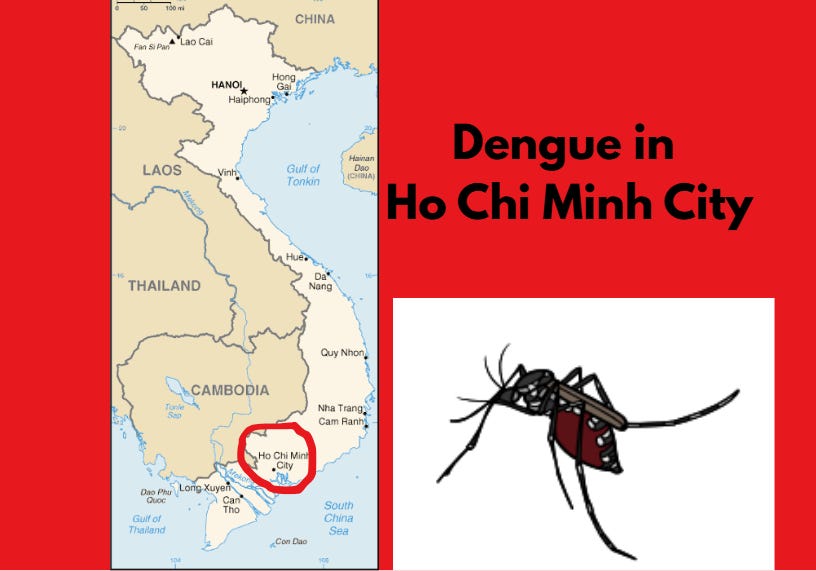
Ho Chi Minh City health officials reported 1,785 dengue cases between October 19 and 25, a figure 9.7 percent higher than the four-week average, according to Outbreak News Today. The city has recorded more than 42,500 dengue cases and 11 deaths since the start of the year.
Outbreak News Today reports that the weekly numbers point to high transmission and that cases could rise further in the weeks ahead.
Why it matters
Dengue is a mosquito-borne viral infection, and the rainy season in southern Vietnam creates conditions in which the mosquitoes that carry it breed and multiply. When weekly case counts run above the recent average, health authorities treat it as a signal that the virus is spreading faster than usual rather than as routine seasonal noise.
The toll in Ho Chi Minh City this year — more than 42,500 infections and 11 deaths — makes dengue one of the city's most significant communicable disease problems of 2026. The figures reported by Outbreak News Today also sit alongside a separate and larger outbreak of hand, foot and mouth disease in the same city, which has complicated the public health response.
Rainy-season conditions and the push to remove breeding sites
According to Outbreak News Today, health authorities have warned that conditions during the rainy season support the breeding and development of disease-carrying mosquitoes. Officials have stressed that eliminating the places where mosquitoes lay eggs, destroying larvae and targeting high-risk areas within residential communities are essential to reducing new infections.
The advice to households is practical and specific. Families are asked to set aside roughly 10 to 15 minutes each week to inspect and clean their surroundings. That includes keeping water containers tightly covered and clearing away bottles and other items that can hold standing water. Regular checks of spots where mosquitoes are likely to breed form part of the same routine.
Residents are also being told to protect themselves from bites and to seek medical care if symptoms consistent with dengue appear. Anyone with a fever is advised to go to a health facility for assessment and guidance rather than taking medication without medical direction.
Warning signs that require urgent care
One of the features of dengue that makes it dangerous is that a patient's condition can deteriorate after the fever starts to ease. Outbreak News Today notes that severe illness can develop even once fever subsides.
Health authorities have listed warning signs that call for immediate medical attention: severe abdominal pain, persistent vomiting, unusual bleeding, lethargy and cold extremities. These symptoms suggest a patient may be progressing toward severe dengue, which can involve plasma leakage, organ impairment or hemorrhagic complications.
The emphasis on seeking assessment for any fever reflects the difficulty of distinguishing dengue from other febrile illnesses early in the course of infection. Clinical evaluation and appropriate advice from health workers are presented as the safer route than self-treatment.
A city managing more than one outbreak
The dengue update arrives as Ho Chi Minh City contends with a substantial hand, foot and mouth disease outbreak. Tuoi Tre News reported that the city has recorded more than 42,000 cases of that illness, while Tech Times put the figure above 44,000 and reported that the EV71 vaccine would not cover most cases. SGGP English Edition reported that the city launched a campaign to combat both dengue fever and hand, foot and mouth disease.
The overlapping outbreaks place sustained demands on the same local health system and on the same households, which are being asked to change daily habits — covering water storage, clearing containers, checking surroundings weekly — while also watching for symptoms in children and adults alike.
What to watch
The key indicator in the coming weeks will be whether the weekly dengue count continues to run above the four-week average as the rainy season proceeds. A sustained rise would suggest that breeding-site control and bite-prevention measures are not yet cutting transmission, while a decline would indicate the response is taking hold.